
Kirkpatrick Isn’t Outdated, We’re Just Using It Wrong
3/2/20262 min read
As an Instructional Designer, I’ve heard this more than once:
“Kirkpatrick is too basic.”
“It’s outdated.”
“It’s just smile sheets.”
But after years of designing programs, leading training teams, and supporting multiple accounts, I’ve realized something:
Kirkpatrick isn’t misunderstood because it’s flawed.
It’s misunderstood because we treat it as a reporting tool. Not a thinking framework.
Let me share how I personally approach it in my projects.
It’s Not About Surveys. It’s About Strategy.
Yes, the four levels are simple:
Reaction — How did participants feel?
Learning — What did they actually learn?
Behavior — What changed in how they perform?
Results — What business impact did it create?
But in real-world corporate settings, especially when handling high-impact programs across different accounts, the mistake I used to see often was this:
Teams start designing from Level 1.
“How do we make this engaging?”
“How do we get good feedback scores?”
Engagement matters — but it’s not the starting point.
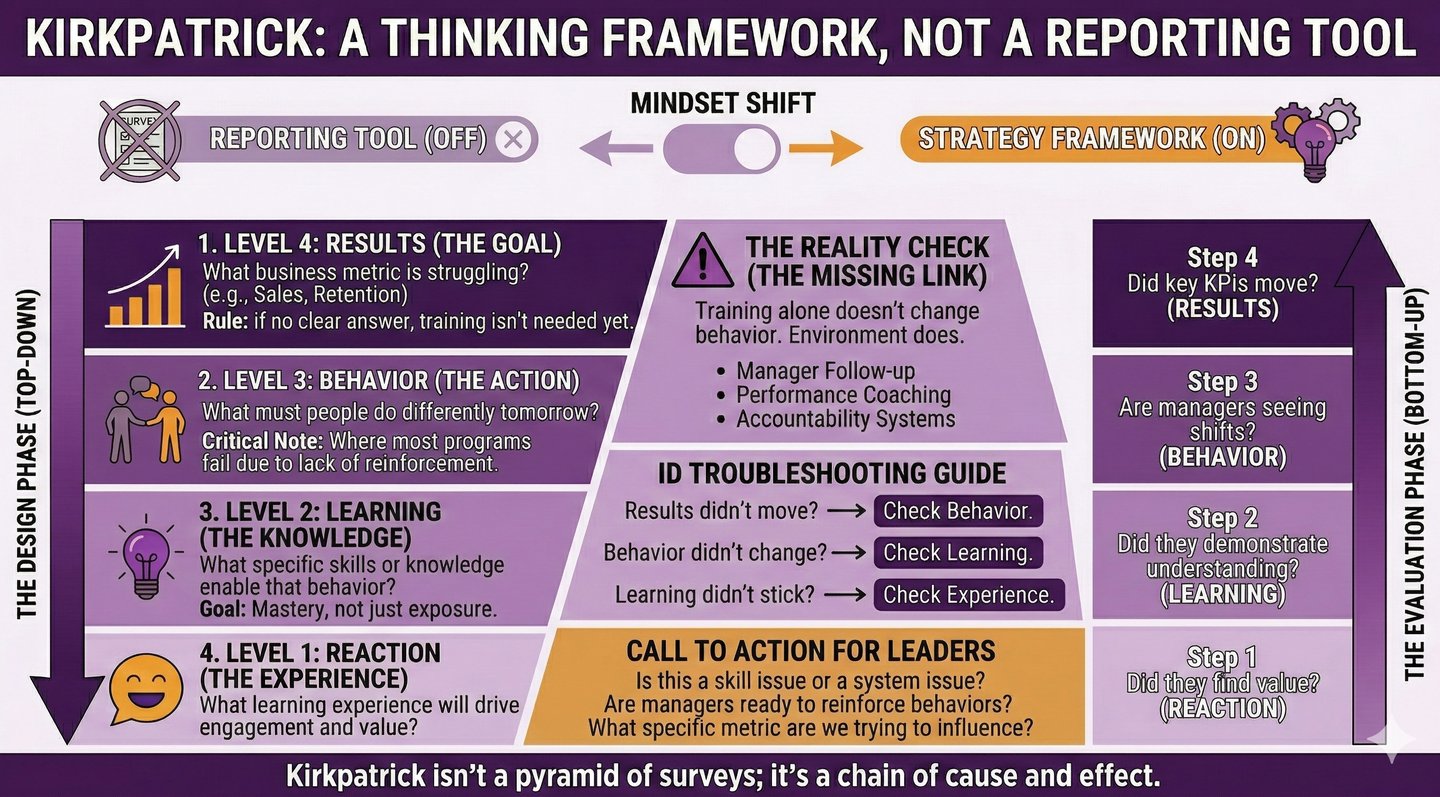
I Design From Level 4 Down
When I handle a project, I start with uncomfortable questions:
What business metric is struggling?
What performance gap are we solving?
What must people do differently tomorrow?
If there’s no clear answer, the training probably isn’t needed yet.
Once the desired result is clear, I work backward:
What behaviors must change?
What skills or knowledge enable that behavior?
What learning experience creates mastery, not just exposure?
That shift alone transforms how you design.
Think Forward. Measure Backward.
Design starts at Results.
Measurement starts at Reaction.
After rollout, we evaluate upward:
Did they find value in the session?
Did they demonstrate understanding?
Are managers seeing behavior shifts?
Did key KPIs move?
As a former Training Manager, I learned that Level 3 (Behavior) is where most programs fail, not because the content was bad, but because reinforcement was missing.
No manager follow-up.
No performance coaching.
No accountability system.
Training alone doesn’t change behavior. Environment does.
For Aspiring Instructional Designers
If you’re new to this field, here’s what I wish someone told me earlier:
Kirkpatrick is not a pyramid of surveys.
It’s a chain of cause and effect.
If Results don’t move, look at Behavior.
If Behavior doesn’t change, look at Learning.
If Learning didn’t stick, look at the Experience.
Everything is connected.
For Businesses and Leaders
Before requesting training, ask:
Is this a skill issue or a system issue?
Are managers prepared to reinforce new behaviors?
What metric are we trying to influence?
Sometimes the solution isn’t another workshop.
Sometimes it’s process redesign, clearer KPIs, or better coaching.
Over the years, whether managing multiple accounts or designing structured learning journeys, this mindset helped me move from “delivering sessions” to “driving impact.”
Kirkpatrick isn’t perfect. No model is.
But when used properly, it forces clarity.
And in instructional design, clarity changes everything.
How do you approach evaluation in your projects?
Get in touch
If you’re a business owner who wants training that drives real behavior change and measurable results — not just workshops — I can help.
Send me a message and let’s design a program that truly moves your KPIs.