
Good E-Learning Design Isn’t Just “Nice Slides”
3/4/20262 min read
One thing I’ve heard a few times in the learning and development space is this:
“E-learning developers just make pretty slides.”
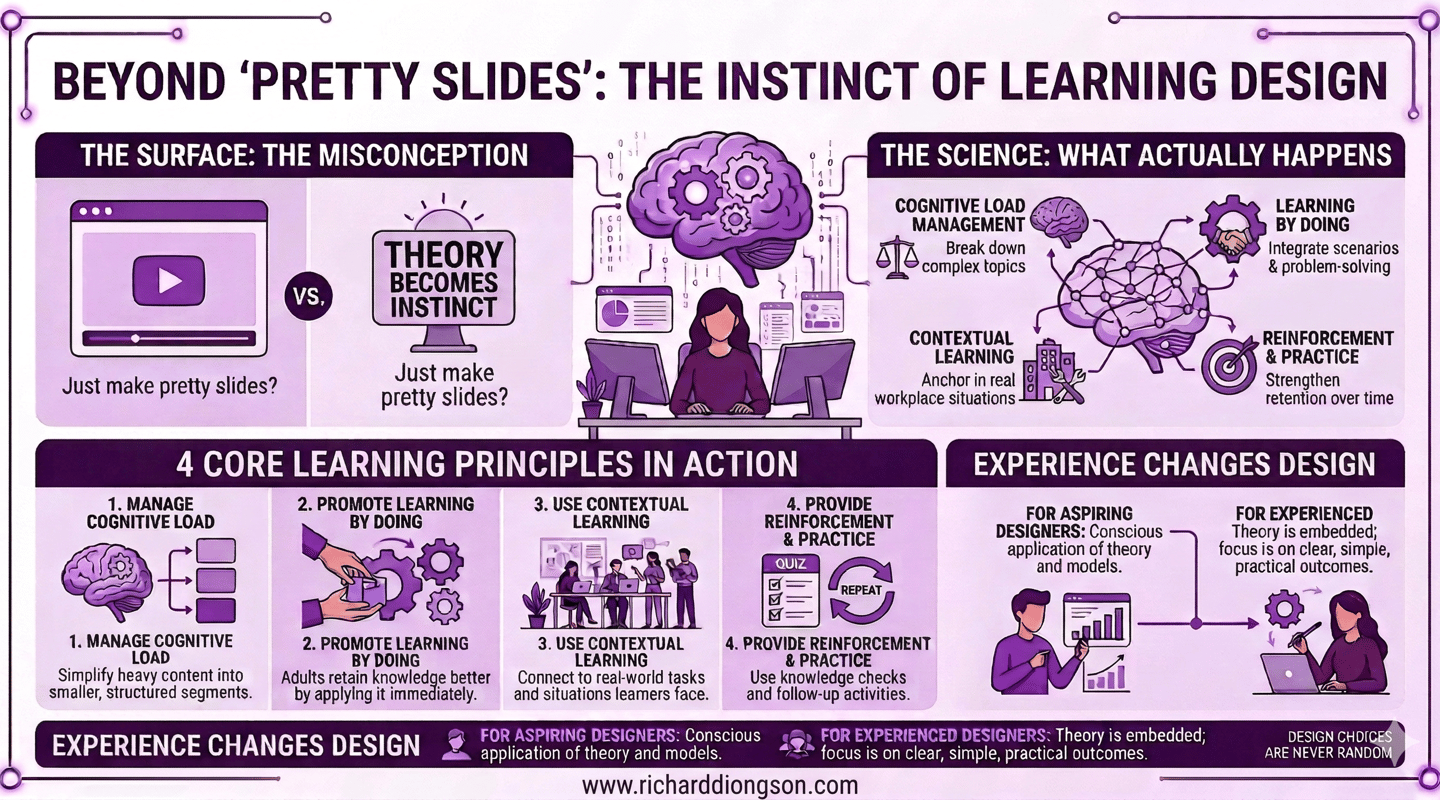
As someone who has worked as a trainer, training manager, and instructional designer, I can confidently say that good learning design goes far beyond visuals. Behind every module, interaction, or activity is a series of intentional decisions about how people actually learn.
When I first started designing training programs, I was very conscious about applying learning theories. I would think carefully about cognitive load, engagement, knowledge transfer, and how learners process information.
But after years of handling different projects, something interesting happened.
Those theories didn’t disappear. They became instinctive.
Theories Slowly Become Design Habits
When you gain experience in instructional design, many decisions become automatic.
For example, when I build an e-learning module or a training program, I naturally think about questions like:
Is this too much information for one slide?
Will learners actually apply this in their job?
Should this be explained… or experienced through a scenario?
These choices are rarely random. They are often influenced by learning principles that most instructional designers study early in their careers.
Over time, what once felt like academic concepts become part of your design instincts.
A Few Learning Principles I Often Apply
In many of the projects I’ve handled, these are some of the learning principles that quietly guide my decisions.
Cognitive Load Management
People can only process a limited amount of information at once. Instead of overwhelming learners with heavy content, I try to break complex topics into smaller, structured segments.Learning by Doing
Adults retain knowledge better when they apply it. That’s why I often integrate scenarios, discussions, or problem-solving activities instead of relying purely on explanations.Contextual Learning
Learners absorb information faster when it connects to real workplace situations. When designing modules, I try to anchor content in real scenarios they might actually face.Reinforcement and Practice
Learning doesn’t stick after one exposure. Knowledge checks, reflection activities, and follow-up reinforcement help strengthen retention.
Experience Changes How You Design
When you’re new to instructional design, theory feels very visible.
You consciously think about frameworks, models, and learning science.
But after designing multiple programs, managing training initiatives, and observing real learners in action, theory becomes embedded in your workflow.
You don’t say, “I’m applying cognitive theory right now.”
You simply design in ways that make learning clearer, simpler, and more practical.
For Aspiring Instructional Designers
If you’re just starting in the field, here’s something important to remember:
Learning theories are not just academic requirements. They’re tools that help you make better design decisions.
The goal isn’t to memorize theories.
The goal is to translate them into practical learning experiences.
Over time, those theories will become part of your design instincts too.
For Trainers and Businesses
Good training programs don’t happen by accident.
Behind every effective learning experience is a thoughtful balance of:
Learning psychology
Real workplace context
Practical application
Clear instructional structure
When these elements come together, training moves beyond information delivery, it becomes performance improvement.
The final module may look simple.
But good instructional design is rarely simple behind the scenes. It’s a series of thoughtful decisions about how people learn, how they apply knowledge, and how organizations improve through learning.
And that’s what makes this field so fascinating.
Get in touch
Great training doesn’t happen by accident. It’s designed with intention, learning science, and real business goals in mind.
If you’re a business owner looking to build training that actually improves performance, I’d be happy to help. Send me a message and let’s discuss how we can design the right learning solution for your team.